The Night the Sky Lit Its Own Holika Dahan
Below, people were preparing wood and cow dung cakes for the bonfire.
Above, the sky had already decided to light its own.
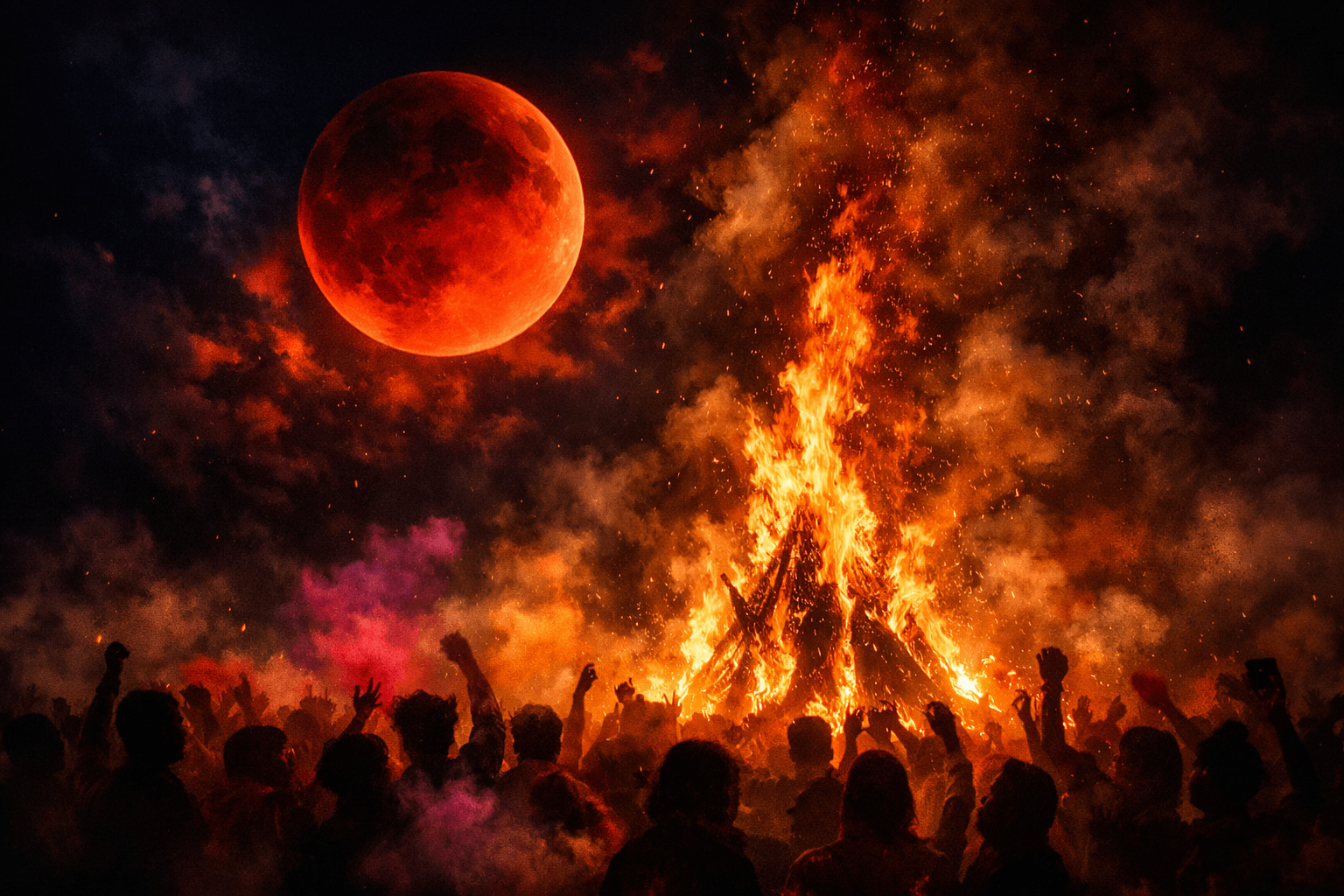
Tonight isn't just Holika Dahan. Tonight, a Total Lunar Eclipse — a Blood Moon — has fallen on Phalguna Purnima. The Moon itself has turned the color of fire. The same red that burns in every Holika bonfire across India.
You can call it coincidence. Jyotish doesn't believe in coincidences.
This Hasn't Happened in Nearly 100 Years
Let that land for a moment.
A Total Lunar Eclipse — not partial, not penumbral — a full Blood Moon — falling on Holika Dahan. The night that marks the burning of evil. The night that marks the beginning of Holi.
The last time this cosmic alignment happened, your grandparents weren't born yet.
And most people are busy figuring out whether to play colors on March 3 or March 4. The confusion is real — but the bigger story is sitting right above their heads, turning blood red, and almost nobody is reading it.
That's why this article exists.
Read the Panchang Before Anything Else
This is Phalguna Shukla Purnima, Vikram Samvat 2082.
The Var is Mangalavara — Tuesday. Ruled by Mars. The planet of fire, blood, courage, and action. On a night when the Moon turns red. On a night when bonfires burn across the country. Mars is the day's lord. This isn't background information — in Jyotish, the day's ruler sets the energy signature for everything that happens within it.
The Tithi is Purnima — the Full Moon. Peak of lunar energy. Maximum strength of the Moon. This is also the exact point at which the Moon is being consumed.
The Moon is in Simha — Leo. The Sun is in Kumbha — Aquarius. Two luminaries sitting exactly opposite each other, as they always do on a Full Moon. The Sun in Aquarius is sitting in Shatabhisha Nakshatra, fourth pada. Shatabhisha belongs to Rahu. So the Sun today is in Rahu's own Nakshatra while the Moon is being swallowed by Ketu. Both luminaries, simultaneously, sitting in shadow-node Nakshatras. That's not a small detail. That's the fingerprint of the eclipse written into the Panchang itself.
And the day opens with Ganda Mula from sunrise until 07:31 AM — the karmic junction point. The day itself enters through a sensitive cosmic door.
The Nakshatra Nobody Is Talking About
Here's where almost every article you've read today has gotten it wrong.
Everyone says the eclipse is in Magha Nakshatra. That's what the Panchang shows at the top. But look more carefully — Magha ends at 07:31 AM. Purva Phalguni begins at 07:31 AM and runs through the rest of the day and night.
The eclipse begins at 3:20 PM IST. Totality runs from 4:34 PM to 5:33 PM. Maximum eclipse around 5:00 PM.
The Blood Moon — the complete swallowing of the Moon by Ketu — happens entirely in Purva Phalguni.
Not Magha.
Why does this matter? Because Magha and Purva Phalguni are two completely different energies telling two completely different stories.
Purva Phalguni — The Nakshatra Being Eclipsed Tonight
Purva Phalguni runs from 13°20' to 26°40' in Leo.
Its ruling planet is Venus — Shukra. Its presiding deity is Bhaga — the god of marital fortune, prosperity, pleasure, and delight. Its symbol is the front legs of a bed, or a hammock — the state of rest before creation. The quality of this Nakshatra is creative potential, enjoyment, artistic expression, and the ease that comes from genuine comfort.
Purva Phalguni people love beauty. They love recognition. They are generous, warm, expressive. They want to be loved and they know how to love. This is Venus's signature in the Sun's sign — the enjoyment of life within a frame of dignity and self-respect.
Now — Ketu is consuming this Nakshatra tonight.
Ketu is the headless body. Ketu has no desire, no attachment, no future orientation. Ketu detaches. Ketu dissolves. Ketu burns away everything that the soul is holding too tightly.
And what is Purva Phalguni holding? Pleasure. Comfort. Creative ego. The need for recognition. The attachment to beauty and enjoyment and a certain softness in life.
Tonight's eclipse isn't about power struggles or leadership crises, though Leo plays a role there too. At its deepest level, tonight is about Ketu asking you: What comfort are you hiding in? What pleasure are you using as a substitute for real growth?
The eclipse burns away false fortune — the kind the ego has constructed to protect itself from discomfort.
The Two Fires Are the Same Story
Holika had a boon. She believed the fire could not touch her. She sat in the flames carrying Prahlad, certain that she would survive and he would burn.
She was wrong. Not because the boon was fake. But because a boon used for the destruction of devotion turns against the one who carries it.
She burned. Prahlad walked out untouched.
Now look at the sky tonight.
The Moon — symbol of the mind, emotions, the inner self — is sitting in Purva Phalguni, in the lap of Venus. Comfortable. Enjoying. Resting.
And then Ketu — the force of karmic dissolution — swallows it whole.
The Moon turns blood red. The color of fire.
The sky is performing its own Holika Dahan.
The ego-comfort that has convinced you it is protected — that is Holika tonight. The part of you that is genuinely devoted, genuinely connected to something real — that is Prahlad. The eclipse doesn't harm devotion. It burns the false boon.
What you've been told won't change, won't crack, won't shift — look very carefully tonight. That's exactly what the eclipse is touching.
Magha Was the Opening. Purva Phalguni Is the Main Event.
Even though the eclipse itself falls in Purva Phalguni, the day opens in Magha. And Magha has its own message.
Magha is ruled by Ketu. Its deity is the Pitrs — the ancestors. Its symbol is the royal throne. Magha governs lineage, inherited authority, the power that comes from who you descend from.
The day opens in Ganda Mula under Magha — which means it begins at a sensitive karmic junction involving ancestry and inherited patterns. The morning says: something old is at the threshold. The rest of the day — the eclipse, the Blood Moon, the Holika Dahan — is the burning of what the morning brought forward.
Ancestral patterns. Old comfort zones. Inherited ways of thinking about pleasure and self-worth. They are invited to the surface first — and then consumed.
This is a full-day karmic arc written precisely into the Panchang.
Sutak Kaal — What You Should Actually Do Today
Sutak begins at 06:23 AM and ends when the eclipse concludes at approximately 6:47 PM IST.
This is the spiritually sensitive window. And most people approach it as a list of things to avoid. That's half the understanding. The other half — which the classical texts emphasize just as strongly — is what to do.
During Sutak Kaal: Avoid cooking and eating if possible. Cover stored food and water with tulsi leaves or kusha grass. Keep temple doors closed or idols covered with a cloth at home. Avoid auspicious ceremonies — no griha pravesh, no marriages, no new beginnings.
During Totality (4:34 PM to 5:33 PM IST): This is the most charged window. The veil between intention and effect is thinnest. Every mantra chanted during totality carries exponentially greater weight. The classical texts are explicit on this — one japa during a total lunar eclipse is equal to thousands under ordinary conditions.
If you do nothing else today — sit quietly during totality and chant. Whatever mantra you carry. Even simply "Om Namah Shivaya" or "Om Som Somaya Namah" — the Moon's own beej mantra.
After the eclipse ends (after 6:47 PM IST): Take a bath. Donate something white — milk, rice, sugar, or white cloth — to someone in need or to a temple. Holika Dahan muhurat opens after the eclipse closes. The post-eclipse window is considered purified and powerful for ritual.
The Numerology Signature of Today
Mulank of March 3, 2026 is 7 — Ketu's number.
Not 1, not 5, not 9. Ketu's own number, on Ketu's eclipse, on a day when Ketu is swallowing the Moon in a Nakshatra ruled by Venus.
Ketu the headless. Ketu the detacher. Ketu who doesn't consume to gain — Ketu consumes to release.
The universe rarely writes this clearly.
For Which Signs Is This Eclipse Most Significant?
Most directly impacted: Simha (Leo) — the eclipse is on your Moon sign. Whatever the Moon governs in your chart — mind, emotions, relationships, mother — is being transformed.
Opposition axis: Kumbha (Aquarius) — Rahu is here. Old patterns around collective identity, technology, and future-building are being shaken.
Square tension: Vrishabha (Taurus) and Vrischika (Scorpio) — relationship dynamics and hidden matters come under pressure.
Who will feel it most personally: Anyone with their natal Moon, Sun, Lagna, Rahu, or Ketu placed in Leo or Aquarius. Check your chart. If any of these fall between 13° and 27° of Leo specifically — this eclipse is sitting directly on your chart's sensitive point.
Who has a window of grace: Mithuna (Gemini), Tula (Libra), Meena (Pisces) — the eclipse creates a trine from Leo. These signs may experience unexpected clarity, an emotional resolution, or a creative breakthrough during and after the eclipse.
What the Sky Is Asking Tonight
People are asking — should I play Holi on March 3 or March 4? Should I do Holika Dahan before or after the eclipse?
These are valid questions. Follow your local panchang and pandit's guidance on the ritual timing.
But the larger question the sky is asking tonight is quieter than that. And it's not about dates.
What comfort are you clinging to that is actually keeping you small?
What pleasure have you dressed up as contentment?
What old pattern did your ancestors hand to you, that you've never questioned, because it always felt like "just who I am"?
The Blood Moon on Holika Dahan is not a warning. Jyotish doesn't read eclipses as punishments. It reads them as accelerations — karmic events that would have unfolded slowly over months, compressed into a single night.
The acceleration is the gift. Pain that would have lasted a year can complete in a week. Clarity that would have taken five years of searching can arrive in a single quiet moment of totality.
Prahlad didn't run from the fire. He walked into it with complete faith. And he came out untouched.
That's the invitation tonight.
The Remedies — Specific and Classical
During Sutak: Chant the Chandra Beej Mantra — Om Som Somaya Namah — 108 times.
During Totality: If you can manage only one thing today, let it be this window. Sit, close your eyes, and chant the Mahamrityunjaya Mantra — Om Tryambakam Yajamahe… — with full attention. This mantra is specifically associated with both the Moon and with transcending fear.
After the eclipse ends: Snaan — a bath with a pinch of sesame seeds in the water is classical for eclipse purification. Then daan — donate white items. Milk, curd, rice, white cloth, silver. Offer these to someone genuinely in need, not as a transaction but as a genuine act of release.
If your Moon is in Leo or Aquarius in the natal chart: Offer water mixed with raw milk to the Moon after it rises tonight. Stand facing the Moon, pour slowly, and simply observe. No complex ritual needed. The sincerity is the mantra.
One thing to avoid: Making major decisions during the eclipse — especially decisions driven by emotional intensity. The mind is amplified tonight, which means both clarity and confusion are louder. What feels like a brilliant idea at 5 PM might look completely different at 5 AM.
The Final Word — Quiet but Real
Holi is the festival of color. Of joy. Of the end of what was dark and cold and dead.
And tonight, before the colors arrive — the sky has asked for one honest look at what needs to burn.
Not in someone else's life. In yours.
The bonfire was lit thousands of years ago to celebrate the burning of a false boon. Tonight, the sky lit its own bonfire — one that will be visible from across half the Earth, turned blood red by the light of every sunrise and sunset simultaneously, refracted through the atmosphere of this planet we share.
If that's not Holika Dahan written in cosmic language — I don't know what is.
Play Holi tomorrow with full joy. Let the colors be loud.
But tonight — sit with the fire. The one above, and the one inside.
Mohit
Related Articles
 Astrology
If Everything Is Written… Are Remedies More Powerful Than God?
Explore the power of Vedic astrology remedies and their role in destiny. Can gemstones and mantras really change your fate?